
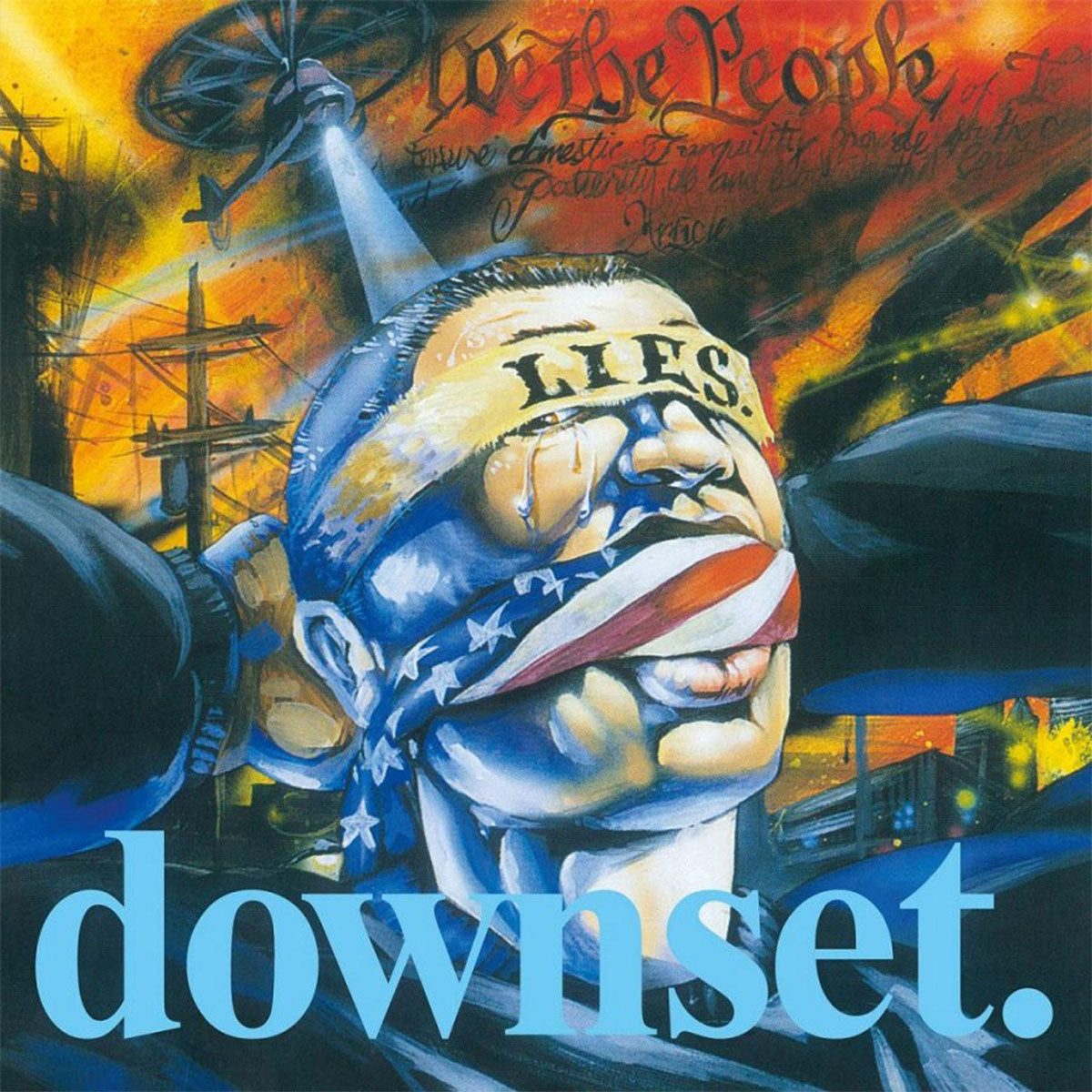
Downset. – Downset.
Released in 1994
I can still remember the day I discovered Downset. It was in high school, on a t-shirt. I did not know at the time, but the image I saw was the cover of their self-titled album. It came as a surprise. Without context. For all I knew, the person wearing the t-shirt was into metal, but this seemed different. The image most definitely exhuded heavyness. However, there was an element of austerity to it. Something angry and political. I had seen cover art for Metallica’s albums. I had seen Slayer’s. This wasn’t it. A face blindfolded by lies. A person with the American flag as a gag. A battlefield, in the background and the Constitution written in a burning sky. At a time when I was obsessed with punkrock, most of my favorite bands conveyed political ideas and discontent, but it was intertwined with lighter themes. I was unable to imagine any lightness about what I was looking at. I made a mental note to look them up, when I got the chance. Keep in mind this was before the Internet allowed you access to a worldwide library of pretty much all that crosses your mind. IF you had a computer at home, and IF you had a dial-up connection, and IF your siblings were not spending their entire evenings on the phone, and IF someone or some record label had a webpage, you might be lucky enough to catch a .wav with an excerpt of a song. I imagine the mental note was buried under a thousand others as it was some time later the idea of looking them up crossed my mind while I was on the computer. What I heard put things into perspective. It was a blend of worlds that did not often cross paths. It was rap. It was metal. It was angry. It was focused. It was no-non-sense. Tapping into that corner of your personality that would not take it anymore. Perfectly eye-opening and proper for a teenager with authority issues. But, how so?
Anger
Anger
Hostility towards the opposition
187
LA trademark
Don’t come to the killing fields if you ain’t
got no fucking heart
‘Cause Willie, Ira and Daryl will get you
Got you
Fucked up and dead will be the way you walk
Damn right
I hate LA swine with a passion G
‘Cause my pops was killed by the fucking LAPD
Yes, they killed my daddy
Yup, they killed my daddy
And if I don’t blast ‘em back, you know they gonna’ fucking kill me
Do me like they did Latasha
Back turned from a gat
Hollow tip to the dome they got ya
April 29
LA swine not guilty
Fools down for the payback on Florence and Normandie
Anger
I’m coming straight from the LA concrete
True blue motherfucker about four generations deep
But who’s the real motherfucker, though
And what does that fake know about motherfucking South Central?
Fool!
What you know about a set or a sign, fake motherfucker
Never ever seen a nine
But if I catch you slippin’ punk, I’m gonna’ fade ya
‘Cause y’all ain’t down with that ghetto perpetrator
Anger
I got that anger
Drop that motherfuckin’ anger
April 29, Florence to Normandie
Jack for my human rights you’re about to catch a puu puu!
818
Yes, they breed the killer
213
Yes, they breed the killer
310
Yes, they breed the killer
They breed the killer, yes they breed the killer
The city of LA
[…] they breed the killer
Straight to a tomb, fool
Bust a cap in them
Seemingly rare are the hardcore and punk records that begin with a few lines spoken over no music. All sampling excluded, of course. Although not entirely unique, this element of surprise is destabilizing and succeeds in commanding the listener’s attention on what is being said, as there is litterally nothing else going on. Reminiscent of what is now known as Slam, one can imagine a dark room with a spotlight on Rey Oropeza. The focus is on words and what is being said. The image being conjured. So, anger is being directed at an opposition, but who would the opposed parties be?
Street culture will be very present throughout the record, and the way the ice is broken is symbolic of exactly that. The term “187”, the first words pronounced over music, referring to the Penal Code 187 of the Law Code of the State of Californiai, is a prominent image in gangsta rap, all over the world. Those familiar with the genre will undoubtedly be accustomed to it, by now. Among the most famous examples of its use would be Dr. Dre and Snoop’s Deep Cover songii, released in 1992, or Master P’s Time for a 187iii. The term has become synonymous with murder, as it is indeed the subject of this particular penal code. More precisely, the “unlawful killing of a human being, or a fetus, with malice aforethought” (Appendix D, p.2). Interestingly, the code contains provisions for 25 and 20 year sentences of imprisonment for people recognized guilty of killing a police officer performing their duty or for people firing firearms from a motor vehicle (Appendix D, p.3). This detail is made interesting by the idea that Dr. Dre and Snoop refer to the code in order to image the murder of an undercover cop, that street gangs have popularized “drive-bys”, and that Downset. are referring to the code to address the subject of police brutality. Therefore, the reference to the code, in this present instance, does not seek to establish street credibility, but rather sets the table perfectly for the issue about to be presented. It is not simply thrown lightly. It is opening the meeting with the first item on the order of the day.
As the context of police brutality has not yet been established when murder is established as an “LA trademark,” one may make the assumption that it refers to the quantity of murders performed in the streets of Los Angeles. However, in retrospect, after the theme of police brutality has been established, it becomes a comment on its alarming recurrence. So alarming, in fact, that a great deal of heart will be required for anyone desiring to survive in such an environment.
The link with the police is drawn so directly that individuals are being called out by name. It could be argued that Willie, the first in the trilogy of names called upon, is a reference to William H. Parker, who was Chief of the Los Angeles Police Department from 1950 through 1966iv. He was chief of the department on August 11th 1965, when riots erupted after things escalated between the police and the community, near Avalon Boulevard and Imperial Highway. A California Highway Patrol officer named Lee Minikus stopped Marquette Frye for possible drunk driving and a few hundreds of people started gathering around them. The help of the Los Angeles Police Department was requested and things went South, figuratively speaking. These events are now referred to as the 1965 Watts Riots. Six days of turmoil, resulting in over thirty deaths, thousands of injuries and arrests, and millions of dollars in damages. The Civil Rights Digital Library states that they were the “largest and costliest urban rebellion of the Civil Rights erav.” According to issue 72 of the Los Angeles Police Museum dating back to April and May 2016 (referenced above), police officers placed part of the blame for the events that took place on a “community out of control” (p.11). Government investigations into the events identified “unemployment and poverty as contributing to the riots” (p.11). Although these factors were highlighted by the commission mandated to take a closer look at the causes and the way events unfolded, the Civil Right Digital Library states that “city leaders and state officials failed to implement measures to improve the social and economic conditions of African Americans living in the Watts neighborhood.” The Watts Riots occuring during William H. Parker’s time as Chief of Police, combined to the impression of failure to effect positive change to the living conditions of the community could be the reason why Willie would be out to “get you.”
The second of the names listed could refer to Ira Reiner, who was the 39th District Attorney of Los Angeles, from 1984 to 1992vi. According to a Metropolitan News-Enterprise article, after thirteen months in office, Reiner announced that two murder suspects would be extradited to a different state for prosecution before he was corrected by the Governor’s Officevii, stating it was not his decision to order extradition. He also dropped charges against five people charged in the McMartin Pre-School child molestation case, a case that had been started by his predecessor. These details contribute to the establishment of Mr. Reiner’s character. Of greater pertinence to the subject at hand, however, his name is more likely listed next to Willie and Daryl’s names because of his involvement in the Rodney King case and the 1992 Los Angels riots. A pattern emerges, with the second reference to riots sparking from police intervention. According to a Los Angeles Times article from 2016 about the 1992 LA Riots, Reiner said he called then Chief of Police Daryl Gates to implore him to take action only to realize the latter was incapable of itviii. However, a more critical point would be the acquittal of the four police officers responsible for the beating of Rodney King which triggered the riotsix. The jury gave their verdict on April 29th, 1992x. As to the direct involvement of Ira Reiner, according to another Metropolitan News-Enterprise article, he was blamed for not putting King on the witness stand and for not resisting sufficiently a transfer of the case from the Los Angeles County to the Simi Valley one, with an “African American population of about 1.5 percent.” His involvement in the trial characterized as ineffective in obtaining a conviction for the police officers caught on tape beating Rodney King may be the reason why he could be perceived as out to “get you.”
The last of the three names might be a reference to Daryl Francis Gates, who was the Chief of the Los Angeles Police Department from 1978 to 1992xi. He was placed on administrative leave, in 1991, after the assault on Rodney King by four Los Angeles police officers, confirming the pattern that was emerging with the first two names listed. On the first day of the riots, a truck driver was pulled from his truck and beaten to death, at the intersection of Florence and Normandie avenues, an intersection mentioned at the end of the song. On a side note, when Gates was 16, he apparently punched a police officer when being given a ticket, but the charges were dropped after he apologized. I am leaving this here in case anyone would attempt at building a racial profiling argument or debate the double standards of privilege. Furthermore, still according to his obituary referenced, earlier, as a police officer, Gates patrolled during the 1965 Watts riot, who also involved the arrest of a motorist. On a second and final biographical side note regarding Gates, he apparently helped create the Police Quest: Open Season and Swat video games. In retrospect, this taps into a certain nostalgia for the 1990’s, as I have fond memories of playing the second title from that franchise, way back when. That was way before I was introduced to the ACAB acronym. Not to imply that I completely adhere to the latter, even though I may understand the sentiment, especially when it comes to profiling. Gates’ involvement in both the 1965 Watts Riots and the 1992 Los Angeles Riots supports the idea that he is indeed the one referenced in the list of names of people out to “get you.”
Rey Oropeza’s anger is not directed at only these three individuals, however, but at the entirety of the “LA swine.” This visceral hatred stems from personal past experience, as Rey indicated in a piece written on Downset.’s website about Anger, back in 1994. In this piece, he states that:
I must say that my resentment and anger can be heard in this song. When your loved ones are murdered by the hands of this system and you are exposed to a lifelong dreary existence at the mercy of the welfare system and practically useless schooling by the LAUSD, I will garantee you that you will build and feel a hate that only a starving poor ghetto-barrio child could fully understand. Driving down the 101 freeway with my homeboy Joke through downtown L.A. I could barely see the tall corporate skyscrapers of this modern babylon through the dingy grey blackened smoke. Within and interwined in these clouds of ashes and smoke I could see thousands of my native american ancestors faces. Limitless corrupted police beatings, dead starving children, homeless, jobless, crying mothers, murders, countless Daryl Gates LAPD and FBI and CIA evil plans, numerous rapes, beggars in the streets, child pronography rings, endless covered up police and government scandals under the name of national security, and even the spirits of of my dead homeboys and my father's soul rising into the sky into the arms of the great spirit.
The anger of a generation was being heard all over this world and I knew from this day on that the people of L.A. would never be the same after this. It was the beginning of the end. Anger. Anger. On April 29 of 1992 love was gone and hatred in the hearts of man was more important than compassion. It is inevitable in a society that treats people like animals... I am not an animal and have been treated like one. I am the descendent of the Native American. I am not an animal or a wetback... I am a human being and as human as ones you love. I am humanity. xii
Not only does this quote confirms the identity of the Daryl mentioned in the song, it also provides a much more detailed backdrop to the song, with both a source for the anger expressed rooted in personal tragedy and an actual witness account for the riots. Rey confesses as much as he reveals his “pops was killed by the fucking LAPD.” The argument is moving further and further away from a generic ACAB cry. There is cause for the outrage.
Combined with the anger expressed is the expression of an intent, as Rey states that he has to “blast ‘em back.” Rey feels compelled and obligated to retaliate in some way because, otherwise, he fears he will be the next one to go. His own personal history, as well as the recurrence of police brutality demonstrated by the police department has instilled an anger in the singer’s heart and calling them out in Anger is the way he might have selected to fire back at them. Raising the audience’s awareness to the cause might just be the way to effect positive change from the riots, potentially succeeding where the authorities have failed, time and again.
So much violence transpires from Anger, and it does not only originate from gang culture or police brutality. The 1992 Los Angeles Riots were not a reaction to an isolated event. The beating of Rodney King was a tipping point for an unrest that had been accumulating through years and years. One event part of that accumulation would be the March 16th 1991 murder of Latasha Harlins by a Korean-American store owner because she thought the victim was stealingxiii. She was shot in the back of the head while trying to exit the store after a scuffle with the owner over the accusations. Hence the lines “back turned from a gat / Hollow point to the dome.” The police found 2$ on Latasha’s body, indicating that she had been trying to pay for the orange juice she had put in her backpack. Sounds familiar? Thought it was a stereotype? Some of you might have seen the Hughes Brothers’ 1993 movie Menace II Society. The intro to the movie portrays the characters of O Dog and Caine going to get OE’s from a Korean-American-owned convenience store only to be pressed to make their purchase and leavexiv. Not to spoil the movie for anyone who has not yet seen this classic, but, in retrospect, perhaps the outcome could be argued to be a reaction to Latasha’s murder. Not necessarely a way to make wrong things right, but maybe a form of revenge. The Wayans Brothers’ 1996 movie Don’t Be A Menace to South Central While Drinking your Juice in the Hood also parodies the Menace II Society introduction scenexv. Even though the latter is a parody movie, it does contribute to the establishment of the stereotype by offering an echo, some years later. If not the origin of the idea that Korean-owned supermakets in the Los Angeles area were hostile towards young african americans, the murder of Latasha Harlins did attract the “wrath of the neighborhood.” How could a 25 square mile area of a city attract so much racism and injustice? The above-referenced LA List article mentions that “[t]ensions had been building for years between blacks who lived in South L.A. Korean-Americans who, like the Dus, ran businesses there.” This supports the idea that unrest had been growing and those in positions of power were either not paying attention, taking appropriate actions, or underestimating the consequences. By referencing to Latasha Harlins, Rey Oropeza not only weaves yet another charged piece of violent history into his backdrop, but he also details how hopeless an environment Los Angeles might have been from a young person growing up. In order to simply survive, one would have to survive gang violence, police brutality, harassment and racism, amongts other hurdles. When some of these elements mix together, over time, a vicious cycle may form. For example, according to the same LA List article, weeks prior to the murder of Latasha Harlins, the son of store owner had to testify in court against gang members who had been stealing and harassed employees. The prevalence of gang culture impacted the community and contributed to the development of racist stereotypes directed at innocent by-standers, who were then literally caught in the crossfire. The tragedy then fanned the flame of another growing racist stereotype, building up an unrest that exploded into riots because of police brutality. On the subject of racism, on May 31st, 1994, before playing My American Prayer, Rey Oropeza said: “[w]e’re from Los Angeles and there’s a big problem there, and it’s called racism. Black Power is bullshit. White Power is bullshit. Any race that has a philosophy that says you’re better than anybody just because of genetic values is a lie. The only superiority you have in this world is the fucking chance to be the best individual you can in this lifetime. Very simple. Racism is a myth. It’s bullshit.”xvi
By this point, references to April 29, not guilty verdicts for police officers or a community out for payback at the intersection of Florence and Normandie have been explained. With the following lines, Rey Oropeza stakes his claim by stating that he is a product of the described environment. The expression “true blue” could be expressing loyaltyxvii to the place in which he grew up. His statement is used as a way to establish that he knows what he has been talking about, as opposed to fakes who would express opinions about South Central without having first-hand experience of gang violence. On May 31st, 1994, before Downset. played Breed the Killer, Rey stated that “[g]ang violence is not to be glorified or to be made fun of.”xviii This supports the idea that he takes the situation very seriously and that he does not condone gang activity. Interestingly, on July 27th, 2014, before playing Empower at the This is Hardcore 2014 festival, Rey dedicates the song as he says: “This one goes out to Roger. It goes out to Freddy, Hoya, Ezec, the whole DMS crew. It goes out to all my lion brothers and sisters in the house today. Keep it coming. This country will never be complete until we figure out who killed Dr. Martin Luther King Jr. We will not be the country that we were meant to be until we find out who did that to him, to Biggie, and everybody else…”xix What makes it interesting is that the quote expresses the complex relationship between gang culture and Civil Rights. It is simultaneously saluting crews, which could be argued to be a synonym for gang, and acknowledging the importance of the fight for Civil Rights.
An alternate version of this song appears on the Our Suffocation demo, in which Rey calls out Zack de la Rocha of Rage Against the Machinexx, in the second verse, saying :
And what does Rage know about motherfucking South Central
Zach whatcha’ know about a set or a sign
Fake motherfucka’ never even seen a nine
But if I catch you slippin’ punk
I’m gonna’ fade ya
This is a direct reference to the Rage Against the Machine song Settle for Nothingxxi, from their self-titled album released on November 3rd, 1992, in which Zack says “I got a nine, a sign, a set, and now I got a name.” The song critiques gang culture being passed down from generation to generation. Rey’s point of contention might have been that Zack would not have sufficient experience of gang culture to denounce it. As though you would have to be a German to denounce the Nazis? It might give weight to a statement, but it should not be the first requirement, should it? Moreover, according to a biography on the ThoughtCo website, Zack de la Rocha lived part of his childhood in Lincoln Heights, Los Angelesxxii. If gang culture was as widespread as Rey Oropeza suggests, it is possible that Zack would have been close enough to experience either some form of it or its impact on the community, living less than an hour away from the area where the riots took place. About the change in the lyrics for Anger between the Our Suffocation demo and the self-titled album, guitar player Rojelio Lozano explained, in a 2024 interview, that “[i]t had different lyrics and they were directed at somebody, at Zack de la Rocha, […] and, so, then, we changed it because we just didn’t… Actually, I, myself, made him change the lyrics because I didn’t want to have any kind of friction with anybody and make enemies right away. Getting in this business, you know, and, right off the bat you have enemies. So, we changed it, and it was still successful for us and it turned out… […] I bring it up because Nuclear Blast also put out a 7 inch of the first demos […] and it has the original version. At first I was reluctant to having it released, I was like, ‘are they gonna’ bring back bad memories and make enemies again…’ You know, it’s part of our history. It’s part of our past.”xxiii The idea that the lyrics were changed at the demand of Rojelio does not indicate a change of mind from Rey Oropeza about Zack de la Rocha’s street credentials, but the lyrics were changed, nonetheless. Hence, one may argue that politics influenced their art. Making things a step more complex is the idea that Downset. covered Inside Out’s Burning Fight on their May 31st, 1994 show at Rio’s Bradford. Inside Out being Zack de la Rocha’s second band. Before playing the song, Rey says “this one is about putting up with all the rockstar bullshit. ‘Cause there’s a lot of assholes out there that always tries to put somebody down for no reason.” Could this have been a way to make amends? Does that make his commitment to fade him if he were to catch him slipping invalid? Or does it display a certain maturity occurred, somewhere along the lines?
Similarly to the way the song started placing focus on the angry reaction directed at forces of oppression, the repetition of the date over and over again attempts at making sure its importance is not underestimated and that it will not be forgotten. At the very least, it states that they will not forget if the authorities have.
Foreshadowing Breed the Killer, a song appearing later on the album, the ending of the song lists three area codes, stating that they are breeding grounds for killers. The first of these area codes, 818, corresponds to the San Fernandino Valley region of Los Angelesxxiv. The second one, 213, “serves the central region of Los Angeles.”xxv Finally, the last area code listed, 310, serves Los Angeles as well as other surrounding cities.xxvi By listing these area codes covering a large portion of Los Angeles and its surrounding area, indicating that they generate killers, Rey indicates that the cycle of violence maintained by gang culture, police brutality and racism, is not centralized in South Los Angels, but widespread throughout.
Ritual
Do you know what it is like to run?
Do you know what it is like to live in fear?
Because she knows what it’s like to run
Because she knows what it’s like to live in fear
Rape ritual
How can I stand in silence while you are raping my sister?
Ritual!
Throw it in the wind because I ain’t with that
Say, what have we done with mother, sister, daughter, lover?
Beat them down to submission
Into that corner of constant fear
Humanity reduced to a sexual commodity, objectification, pretty faces
Molded imagery
Damn they drop the dirty mack demands
She’s more than booty to me
Bypass her sexuality
Tradition
Your sexism is what you want me to learn
Surrender gender hatred
Fade it to kill it
Compassion returns
One out of three, and they say my sisters are free
Incarcerated by hatred
Propagated by sodomy
Continual ritual
Victimizing my sister
Physical rape is psychological murder
Ritual!
Jenny! Hoe! Slut! Trick! Bitch! Buddy!
Terms that burn in our popular brutality
That media camera’s at you
Trying to show you what’s up
Illusion magazine
Fantasy got you fiending to bust a nut
Body identity suffocates in her nudity
She’s dying inside
Fashion’s asking
Won’t let her be
Strip her to flesh for apathetic male ego
You bet the set ain’t down with your wack rape ritual
We got to meet this hate with love
We got to meet this hatred with love
Why do we fall for it? Fuel it?
Sexual violence equality?
Please
So-called alternative movement statistics never confess her wounded aloneness
Internal inferno
Locked away
Calm diminishment
Sharon Stone, you ain’t all that
Madonna, you ain’t all that
Sell you shallow shock value
Charade is wack
Sister, put a fist in what’s expected of you
Deny! Defy!
False definition of you, too
There’s no excuse for this brutality or this lack of humanity
Rape ritual
I say I throw you into the wind
I say your traditions means nothing to me
Similarly to how Anger presented the violent environment of Los Angeles to an audience that might be unaware, informing an outside world of a reality that contrasts their, Ritual introduces another victim’s point of view. This time, the issues at hand are rape and the subjugation of women. By showing rape as a ritual, Downset. is suggesting that rape does not occur randomly, all over the country. It posits that it has become part of a culture. That the horrible act has perhaps taken a more subtle and insidious form, through normalization.
Just as police brutality had been identified as a trademark of Los Angeles, the word is once more applied. By referring to the victims of rape as “mother, sister, daughter, lover,” Rey removes the distance that desensitization would have placed between the victims and the perpetrators or the audience and the issue. Once the listeners are able to imagine the victims as loved ones, it becomes more difficult to ignore the issue or turn a deaf ear to it. Interestingly, the victims may be people close to the public, but so may the perpetrators. A retrospective study published on the National Library of Medicine comparing sexual assaults done by strangers in comparison to those done by people known to the victims observed that, in 76% of the cases they reviewed, the sexual assault had been committed “by a person known to the victim.”xxvii Moreover, 68% of the assailants of these cases were acquaintances of the victims. 21% of the 849 cases reviewed identified the perpetrator as the “boyfriends or spouses.” This is corroborated by the Amnesty International website.xxviii When Rey asks his question, making sure the victims are identified as direct relatives or intimate partners, he highlights the alarming nature of inflicting such suffering on those we claim to love.
The point of view of the victims adopted by Rey describes victims being forced to both “run” and “live in fear.” Rey calls upon the audience’s empathy, asking them to place themselves in the shoes of these victims. He describes the living conditions of these victims as beaten “down into submission / into that corner of constant fear.” These acts can take various forms. It can take the shape of objectification, exploitation, sexism, or the actual physical act. As to the source of the influence for such behaviors, one potential suspect could be the society standards for beauty. Keep in mind this song was released around four years prior to the release of Britney Spears’ Baby One More Timexxix, which, it could be argued, triggered the appearance of the debate on the oversexualization of teenagers in popular culture (for the generation who grew up in the ‘90’s, at least). Shedding a light on how these people we should love must be feeling and all these processes ranging from subtle, unconscious influence to all out physical pain being inflicted, Rey Oropeza is stating that society is overdue for an examination of its conscience.
In a 2017 article published on Frontier in Psychology, Bhuvanesh Awasthi reviewed various studies and new findings related to the role of appearance, objectification, perception in instances of assaultxxx. The abstract of the article states that “[s]exual violence is a consequence of a dehumanized perception of female bodies that agressors acquire through their exposure and interpretation of objectified body images” (p. 1). The claims that rape victims were asking for it because of the way they dressed have been heard too often, throughout the world, but when does attraction and arousal turn into objectification? And when does objectification motivate assault? Amongst the studies reviewed for the Bhuvanesh article, one observed that “when wearing underwear or a swimsuit, a person could be viewed as a mere body that exists for the pleasure and use of others (Bartky, 1990)” (p.2-3). Another study observed that “focus on appearance rather than on personality diminished the degree of human nature attributed to females (Heflick and Goldenberg, 2009)” (p.3). The less human nature one confers to a person, the more they objectify them. Other studies reviewed observed that “[s]exual objectification has more adverse consequences for women than for men (Moradi and Huang, 2008; Saguy et al., 2010; Gervais et al., 2011), affecting mental health, intellectual performance and increasing the risk of depression (Jack, 1991; Whiffen et al., 2007)” (p. 3) and that “[o]bjectification also tends to make women behave as lesser beings in social interactions (Saguy et al., 2010)” (p. 3). These observations support Rey Oropeza’s message as they identify women as suffering more negative impacts of objectification than men. The Bhuvanesh article also looked at the experiments conducted by Vaes et al., in 2011xxxi, that indicated “that only objectified women were associated with less human concepts” (p. 3) and “that sexually objectified women shift a man’s focus toward a female target, away from her personality and more onto her body, triggering a dehumanization process” (p. 3). The same experiments also observed the perceptions of women towards other women, who reacted “by distancing themselves from the sexualized representations of their own gender category” (p.3). Rey pointing a finger at “molded imagery” as sharing part of the blame in the negative way in which women are treated is therefore supported by many studies observing the impact of appearance in the objectification of people and the effects objectification has on the perception of others.
On a piece describing the motivation behind writing Ritual on Downset.’s website, Rey wrote:
Rape… physical rape. The raping of women is the physical manifestation of a society that continually prop[a]gates women as being nothing more than sexual objects and sexual commodities. Out of all our songs, this statement is one [of] the most valued to me (Rey). I do think that most people do not really understand the immense size of this problem, it affects 1 out of every 3 women and 2,000 rapes a day is a burden that sets in my deepest of self. It's everywhere I go... TV, sexist music, billboards, etc... this illicit sexual propaganda is everywhere and it's shoved down my throat. I wish I could eject it but it's still in the air and worse than that, the majority of people in this age just don't give a fuck!
We are exposed to a continual false definition of womanhood. Is the shock value traits Madonna and Sharon Stone, etc. the sure and true definition of modern day females? I think not. I myself have talked to many women who are mostly under the age of 25 and most of them are hurt and sickened at the treatment they get from the male populus. Also their cry silent opposition to many actresses and performers of all kind because they feel that most males get their definition of womanhood through the eyes of the high sexual media imagery and through the sexually blated modern day definition of this brutal popular culture.
There is more to a woman than her breast[s], legs, eyes, face, hair, skin, etc... What have we done? In the name of all that is right! What have we done to our sisters? In the name of our corporate economy which parasites and targets our animal nature and sexuality. In the name of our modern day entertainment we have reduced women's modern day purpose to be nothing more than sexual. In my opinion, bulimia, anorexia, insecurity, obsessive body consciounsness, self-hatred, feeling of weakness and low self[-]esteem are all results of our plastic narrowed definition. A magazine movie womanhood.
I must say that I am a male. A heterosexual male who has a deep feeling and hurt about rape and it's victims. I have never been sexually assaulted so I can understand only a fragment of this. What the fuck are we going to do about this brutality against our sisters? I feel so fucking angry! I swear I feel so hurt! What more can I say to have you reconsider your gluttonous sexual demands and attitudes. I do not feel like I have said enough in this explanation to have you fully grasp a woman's feelings as a rape victim but I can tell you that I believe that if we do not reconstruct our society's treatment of womanhood and try to stop and at least be objective to the exploiting propaganda we are exposed to everyday, that the savage and brutal rapes and treatment of women is an unnavoidable occurrence in our modern times.
Is it really fucking worth it? NO! Fuck no! If you are a victim of rape it is not your fault and you are not to blame! I have faith in my sisters! You can overcome this theivery.. is this a sexual exploitation? I think it's a fair question. My feelings are with you my sisters.xxxii
The complacency of a society allowing half of its population to be sujected to the various forms of rape transpires from the quote, and it only facilitates the assimilation of the stereotypes of beauty vehicled by the media, implanting a “false definition of womanhood” in the minds of people all over the world. These images, capitalizing on a certain thirst and attraction, only benefits corporations selling products, while turning half the population into animals reacting to instincts, and subjecting the other half to a life of fear, self-doubt and feelings of inadequacy.
Ritual is about rape. It is about the objectification and subjugation of women through prostitution. It is about sexism. It is about the female models put forth by the mainstream media and the fashion industry influencing generations to come. It is also about how the victims of these treatments are the ones imprisoned by these mechanisms and everyone allowing it are the jailors making sure they cannot escape. The penal system metaphor is supported through the lines “incarcerated by hatred” and “locked away.”
In addition to identifying the victims of this rape ritual, there is an emphasis placed on the impact it has on their lives. Being beat “down to submission,” forced to live “in a corner of constant fear,” being “reduced to a sexual commodity,” objectified, perceived as mere “pretty faces” or just a “booty,” being subjected to sexism and “gender hatred,” being labeled as “Jenny,” “hoe,” “slut,” “trick,” and “bitch,” are all elements that generate a “bypass” to their sexuality. It has an effect on them that transcends physical pain. That is what Rey qualifies as “psychological muder.” It influences the way the “body identity” is developed, shaping their self-perception, hinders the growth process, and causing internal death, to a certain extent. Through it all, no justification is offered as to why such “brutality” and “lack of humanity” should be directed at them. Although the origin remains mysterious, the solution is not so, according to Downset. “Love” and “compassion” are the keys.
Take ‘Em Out
Gotta’ flex that skill
Yup!
As I watch them kill
Greed
The seed
It’s called inequities
Vanity
Banking
Ganking
Justified
How many more will have to suffer?
How many more will have to die?
Well, stop buying the lie
Bold beautiful crying brown eyes
Technical superstate built on the means of hate
Dominant symbol
Corruption escalates
Can they distinguish life from death?
Should a dollar bill give a man a right to kill?
Hell no!
Because life is priceless
This fight from the affirmative
Wicked brutal force of course justifying the means
Death with no remorse
Covert operations above the law
Killing for God, for countries
A fraud
Got to take ‘em out!
Violation of human rights
For the life of the suffering
Symbol of wickedness
Post-dictatorship economic elite
Starving children bowing to their feet
Smokescreen patriotism
Won’t deny the lie
Can’t cloud my soul vision
F.E.M.A.
See you
Got you on sight
No law should cut constitutional rights
No one more hopeless than those that think they are free
Bounded minds of this human machinery
What I am is what I am!
Crying to jah
You know I am praying for payback
All truth will soon come
Be in light
Federal judge
You know they got them on check
Federal courts
You know they got them on check
Central banking system
You know they got them on check
Federal agents
You know they got them on check
Federal prisons
You know they got them on check
Population control
You know they got it on check
Cry for life
Gotta’ take ‘em out
The world depicted in Take ‘Em Out is divided into two classes opposing an elite, relying on tactics not unknown to gang culture in order to maintain their position, and those suffering in the name of their profit. Characterized by “greed,” “vanity,” “corruption,” dominance, being “above the law,” Religion, wickedness, and patriotism, this “economic elite” has established a form of “population control” through the corruption of “federal courts” and judges, the “central banking system,” “federal agents,” as well as the “federal prisons.” In Downset.’s class war, profit is placed above human interests.
In a 1927 article discussing the League of Nations, Edward A. Harriman defines the term “superstate” and indicating “merely that there is an organization, of which a state is a member, which is superior to the members themselves.”xxxiii If Downset.’s reference to a “technical superstate” were about technology, the term should have been “technological superstate.” Therefore, “technical superstate” rather hints at a “technicality” on which superiority is established. It is possible that it has only been affirmed by projecting an image and is simply a matter of perspective.
In defense of Life, Downset. proposes to “take ‘em out” and end this “violation of human rights” and starvation of children. A paralel is drawn between this struggle and the one of the Rastafari movement through a reference to Jah, to whom Rey would be “praying for payback.” According to an article published on Black History Month website, the movement would be, in part, based on the teachings of Marcus Garveyxxxiv. In a 1921 speech, Garvey called for unification of his “fellow citizens of Africa […] for the purpose of bettering our industrial, commercial, educational, social, and political conditions.”xxxv However, if Garvey saw each race as being responsible for the fight for their own destiny, separately, this reference to the Rastafari movement would be the only allusion to ideas of Race.
If the “economic elite” refers to an abstract entity, there is one entity that is called out by name: FEMA, which stands for the Federal Emergency Management Agency. According to their website, they are an organization “helping people before, during and after disasters.”xxxvi The connection between an agency providing help to people, at a federal level, and the opposition between two social classes can be unclear. The lines “see you / got you on sight / no law should cut constitutional rights” do not provide sufficient details on the point of contention other than there may be an infringement of constitutional rights. When it was created in 1979, by Jimmy Carter, its mandate was to manage emergencies and civil defenses. In 2003, FEMA was merged with other 21 other organizations to create the Department of Homeland Security. As Downset.’s record was released in 1994, whatever the criticism may be, it has to be based on an event that occured before then. Their management of civil rights may be a clue. According to the US Constitution website, federal aid to a state requesting it has to be authorized by the president.xxxvii It also states that “some have questioned FEMA’s constitutional validity due to its establishment by executive order.” The idea of cutting constitutional rights appears closely related to acting on questionable legality as it evokes an idea of an assumed authority. Is it possible that injustice was done under the guise of crisis management? Amongst the results generated when researching for such an eventuality is the idea of a certain fear to the effect that, in the event of a crisis, civil rights could be suspended by FEMA (through declaration of Martial Law, for example), allowing them to detain citizens or move them into camps.xxxviii Extrapolation and a negative opinion of the authorities might lead one to fear that such power could be used and abused to remove certain individuals.
Take ‘Em Out’s depiction of a class war opposing an “economic elite” placing corporate interests over human lives suggests those in control have become too powerful. There could hardly be a more American response than Rey’s call to arms, as it it textually woven into the very fabric of the nation, when then Declaration of Independence states:
We hold these truths to be self-evident, that all men are created equal, that they are endowed by their Creator with certain unalienable Rights, that among these are Life, Liberty and the pursuit of Happiness.--That to secure these rights, Governments are instituted among Men, deriving their just powers from the consent of the governed, --That whenever any Form of Government becomes destructive of these ends, it is the Right of the People to alter or to abolish it...xxxix
Under the surface, however, it is designed to serve as a wake-up call to the oppressed and a reminder to the authorities of their own history of emancipation.
Prostitutionalized
Gots no Milli Vanilli in me
Sincerity
Constantly
No prefabrication
Prefabrication!
The words live free
Question the intentions of this alternative generations
And do we even realize all that we do affects all life?
Let us not stifle statement beneath false egos, style, or trends
Or we surrender that which can salvage human life
Can’t prostitutionalize it
Will we let the external taint the internal?
Be the brother in struggle
But don’t sucker yourself
Our words exceed the eminence of the musical
Is Doc Martens more important than a movement?
Or is it so cheap that a passing style is what makes you sleep?
You must understand the value of your light
Don’t prostitutionalize it
These eyes will not sleep
I am more than a musical byproduct
There is continuity between Take ‘Em Out and Prostitutionalized, as both imply that profits are prioritized over human interests. The desire to attain the highest levels of popularity to ensure financial gain or adulation implies a certain amount of catering, as creativity is directed by market research. Supply and demand. Reliance on the example of Milli Vanilli demonstrates both the message and poetic justice for Downset., who acknowledge the revolutionary potential and the sanctity of music.
A German lip-syncing duo, with low English proficiency, thick accents, but perfect English appearing on their records (even In Living Color parodied themxl), achieving commercial success, selling 14 million records worldwide, and 33 million singles, with videos all over MTV, performing on-stage and experiencing technical difficulties when their songs starts to skip.xli Ironically, they even won three American Music Awards and a Grammy for best new artist, which they had to return.xlii One more layer of irony would be that the song performed when these technical difficulties occurred was actually released two years prior by another band from Baltimore.xliii The history of Milly Vanilli illustrates the absurdity of the process and reveals its somber mechanisms.
Prefabrication takes place when, for example, a white German producer creates songs and hires two people to lip-sync them. When the producers refuse to consider using the vocals of the artists they have hired to lip-sync because their mind is set on using a specific kind of vocals to sing their songs. When they push their arrogance as far as relying on different singers between singles, thinking the audience would not notice the change, although the lip-syncers remain the same. When the lip-syncers never even meet the true singers. It takes place when the parties involved analyze other pop icons to determine a formula designed to please an audience better. In this instance, Fab Morvan has stated that the choice of the adoption of dreadlocks was made upon the realization that other celebrities were recognized because of their hair.xliv Prefabrication occurs when the artists are performing because they are contractually obligated to do so, and not because they feel the need to express themselves. Prefabrication can also take the form of a predetermined recipe for success, which can be replicated from artist to artist. For example, once an artist has reached the top of the charts in Europe, they should move on to conquer America.
In his interview to VladTV, Fab Morvan confessed the negative effects he would experience, after they had enjoyed their fame for some time, when he was alone after everybody had left the aftershow party. As the singles increased their popularity, which rested on their secret being kept, so did the internal effects of the fraud. Combined with the fatigue of an unrelenting schedule and the coping mechanisms developed, the physical and mental consequences question the process. All the accolades they would receive from an industry they were trying to seduce would only have a bittersweet taste. After the fraud was revealed and admitted, Rob and Fab even faced lawsuits. Is this practice only worthwhile for those who can sustain the lie? What about those going through the charade only to realize that they cannot?
Illusions generated to exploit trends is central to the mainstream entertainment industry. The exception taken is not exactly about achieving commercial success. It is rather about using this commercial success to manipulate kids. In this case, the “alternative generation.” Why would major record labels pay any attention to a group of dirty little kids if not for the opportunity to profit from it? Once a band like Nirvana, for example, signs to such a label, and a lot of other bands with similar sounds and attitudes start appearing, and their videos suddenly get played on television, does it not look suspicious? Artists interviewed for the documentary titled the Chaotic Rise & Fall of Alternative Rock acknowledge the climate change that occurred at the end of the 1980’s and beginning of the 1990’s, once major labels began showing interest in the movement.xlv What used to be confined to timeslots nobody wanted were all of a sudden played during the day. After the market is infiltrated and the product becomes diluted, it becomes harder to sort out the prefabrications from the genuine articles. This is the doubt Downset. is showing when they question the “alternative generation.”
With the question “[i]s Doc Martens more important than a movement / or is it so cheap that a passing style is what makes you sleep?” Downset. are questioning the reasons people are drawn to a certain style. A paralel may be drawn with H2O’s What Happenedxlvi, in which Toby can be heard wondering how the hardcore scene has turned into a fashion show. When people are drawn to a music genre because of the aesthetics, some of its potency may be left on the table. When Rey states that he is more than a musical byproduct, he expresses his desire to be recognized for the ideas coming out of their texts, rather than being sold as an image printed on posters to attract investments. In support of that idea, before playing Prostitutionalized, on May 31st 1994, at Rio’s Bradfor, Rey said that “[i]n the course of five years, this music might not be so much important. The lyrics we have to offer you as a band are timeless because a statement is timeless. So I ask all you people here, if you guys wanna’ buy our album -we got an album coming out July 12th […] if you gotta’ chance, buy it. Read the lyrics. Check ‘em out. It’s the most important thing to me. […] Don’t just come to a show, drink, get drunk, smoke cigarettes, and fucking bang your head. Because in five years, that’s not gonna’ mean anything at all.”xlvii Once more, attention is drawn to the revolutionary potential of the media, in contrast to adhering to a style because of peer pressure.
Downset
Well, I’m doing this from that place where the young bodies stuck to bluest of blue skies
A child grown quick
Kicking it with an icepick
Age of 8
Babyface
Straight up scared to die
Seen one little, two little, three little homicides
Kids don’t rank so they shank in front of baby eyes
Bullet-scarred
Prison-barred
The one times got my face to the ground
They want me down
Downset at the bottom
On the come up to say some
Down
Downset at the bottom
Coming up from the slum
Down! Down! Down! Down!
Bronze complexion
Converse and khakis
Enough for the fuss of C.R.A.S.H. to straight jack me
Brothat, brotha, brotha
How you make ‘em get down?
Systematic static can’t stifle the set’s sound
Jack for the mic and I’ll still get it going on
Making my statement with a fatcap and Krylon
Peeping my voice from the LA underground
The plan from the man is to demand they keep me down
Downset at the bottom
Got ya! Got ya!
Yeah, you know I straight ya!
Reveal to heal in our sectarian obstacles
Wipe the dirt off the eyes of the hate child
Damn with the program
Imposed since the juvenile
Shit is so thick
You don’t want to deal with it
Set’s got heart to consist like an activist
Ain’t going to live in comfort while shit gets worse
I got the voice of the voiceless and life comes first
So what are you going to do?
What are you going to do?
What you gonna’ do when the shit comes down on you?
The set’s gonna’ be down
Yeah, you know, like we’ve always been
The ghetto survivors got no soldier extinction
The man ain’t down with multiethnic ethics
Division is wicked and Downset ain’t with it
My word is my fire for life and love is the sound
You got to kill me to silence me, fool
You can’t keep me down
Downset at the bottom
Freedom in a cage
Trauma is part of growing up as every new experience is bound to change the individuals going through threm. Witnessing homicide repeatedly, at a very young age, will undoubtedly leave a mark. Through a few autobiographical lines, the audience is once more exposed to ideas of what childhood might have been like for those growing up in Los Angeles. It raises the question of expectations for those coming of age through these hurdles.
When Downset. is located at the bottom, it may suggests that they have hit the proverbial rock bottom, but it also may imply that they are being kept at the bottom because of access to elevation and opportunity. A glass ceiling, perhaps? The lines “bronze complexion / Converse and khakis” suggest profiling, which, it could be argued, is a mechanism that prevents its victims from reaching higher standards. Profiling and harassment go hand in hand and generates aggravation, apprehension, and a negative outlook towards the perpetrators.
It is possible that the reason why so many homicides were witnessed, growing up in L.A., might be linked to an increase in gang activity. Drawing upon the references of Anger, the shadow of Chief Daryl Gates reappears, through the mention of the Community Ressources Against Street Hoodlums (C.R.A.S.H.) program.xlviii In reaction to the expansion of gang culture towards the end of the 1970’s and beginning of the 1980’s, the city created a program with the mission of targeting gang members. Part of the training of the police officers assigned to this unit involved learning as much personal information on gang members as possible. Studying gangs from the outside and interacting with them on a daily basis may be perceived as similar to profiling, as they would develop a certain knowledge of gang attributes and rely on this knowledge during their daily activities. Their routine involved patting down suspected gang members and questioning them, under the guise of casual interaction. In the PBS Frontline article just referenced, Sergeant Brian Liddy, a member of the task force, is quoted describing the Los Angeles Police Department as such: “it doesn’t have any real corruption problems, so to speak of. It’s an honest police department. It can be called a lot of things. But until now, it’s never been called a dishonest police department.” However, a Law & Order episode on the Rampart Scandal released in 2000 reports otherwise,xlix comparing the division to the criminals they were mandated to oppose. In a different PBS Frontline article, the case of Rafael Perez is explained, detailing how a former police officer was caught stealing drugs from the LAPD evidence room and then testified on the corrupt practices plaguing the department.l Profiling, oppressive methods characterized as “systematic static,” and corruption are therefore the elements evoked through the reference to the complexion and the way Rey dresses.
Downset symbolizes the manner elected to denounce the oppression Rey has experienced and witnessed, living in Los Angeles. Through the use of a “mic,” as well as a “fatcap and Krylon,” which could be qualified as peaceful protest, the situation is shared with an audience. Through words such as “heal,” “heart,” “life,” and “love,” the suggestion is made that one should prioritize the interests of individuals rather than seeking to perpetuate a cycle of violence. That resolution will not come by living “in comfort while shit gets worse.” That because one is born in an environment imposing such conditions does not mean they have to accept it.
My American Prayer
Metzger! Farrahakan!
Yup, we got it going on
Race in the mix and melting pot’s hot
Well, I don’t know where you’re at but I know where I’ve always been
Downset at the bottom with my underclass freedom
The birth of this nation
Birth of the systematic jack
From land grab to whips across black’s back
No progress
Money means more
Humanity less
Nothing done changed in this land of soaked bloodshed
Racism? Guilty!
Thievery? Guilty!
Sexism? Guilty!
Executed traditionally
Living in the shadow of five centuries
Misery
Homie blind
Forced in your game
Choked equality
Why am I gonna’ be like that?
Why must I pack that vocal gat
Because of the blood of humanity
Your pockets are getting fat?
This is America the hateful
I’m gonna’ be down to live this protest
I’m gonna’ be down to die this protest
America better check itself before it wrecks itself
Because differences seem to be bad for its health
Black! White! Yellow! Brown! Christian and muslim!
Heterosexual! Homosexual!
All want to get some
Democrat! Republican!
They putting that work in
Aryan nation! 5% nation! Native American wants division
Man’s diversity is Amerca’s biggest enemy
N*****! Woods! And eses’ stifled with apathy
Standing strong like a soldier
Struggling like a soldier
Taking bullets of hatred
Watching my soul get colder
Circumstancecs dance on interracial romance
Separatist fist bomb on this love at first chance
America taught me to hate you
America taught me to hate you
Taking shot at the external even though I never knew you
Will you fade and follow
Doubtless
Next in the death rate
Or love
Suffocate beneath this fashion of hate
I was taught to hate you
And you were taught to hate me
Love sees no color
But America always will
Humanity means nothing in this place where we learn to kill
I don’t believe in this hatred anymore
Red, white and blue is gonna’ kill you
I throw the brick of my protest through the window of your inhumane corruption
And watch the fragments of your greed shatter to the frigid ground
And it’s like that
Martin Luther King
Ruben Salezar
Malcolm X
John F. Kennedy
Red, white and blue is gonna’ kill you
The name of the leader of a white supremacy groupli mentioned next to the one of the leader of a black muslim grouplii suggests some form of association between the two, although, at first glance, both groups might appear to be at opposite ends of an ideological spectrum. However, one of the common grounds between the two would be their hatred of other groups based on race or religion. One point on which both of them align exactly would be anti-semitism. Racism has been a recurrent theme, so far, throughout the album. Songs also often reference to other songs both in ideas and in direct quotation. For example, My American Prayer borrows the phrase “Downset. at the bottom” from the song Downset. This repetition of certain elements brings to mind an intrically woven pattern mixing violence, racism, and social justice. In addition, Downset. references other artists to support their claims, establishing that it is not only them expressing their disapproval. When they say “America better check itself before it wrecks itself / because differences seem to be bad for its health,” undoubtedly a reference to Ice Cube’s Check Yo Selfliii. This association with a fellow Los Angeles resident provides strength in numbers to Downset.’s depiction of their environment. It is no longer their own assessment of the situation. It is becoming generalized.
According to the Southern Poverty Law Center article on Thomas Metzger cited previously, he quit an anticommunist group he was a part of because they did not “share his antisemitic zeal.” In addition, he was promoted to the state of California leader of the Knights of the Ku Klux Klan by David Duke. He also rose to the position of minister in the Christian Identity movement, a group recognized for their antisemitic views.liv In 1980, he won a seat at the American Congress, foreshadowing a speech he gave in January 2004 at a hate-rock concert outside of Phoenix underlining the necessity of infiltrating the military, the government, and law enforcement, in order to further their racist agenda.lv On a general knowledge side note, for those desiring to see the individual’s influence in action, one may look at the 1988 Geraldo Rivera show when a scuffle erupted between Thomas Metzger’s son and Roy Innis during which Geraldo’s nose was broken by a thrown chair.lvi This resume provides support for the idea of Metzger being a racist and antisemite. Furthermore, in 1985, Metzger and his followers demonstrated their support for the Nation of Islam and their leader, Louis Farrakhan, reinforcing the link between the two groups and the relation between the two names, as used by Downset.
Affirmation, identity, justice, are a few of the themes that transpire from interviews with Louis Farrakhan. However, these notions that could be established as having a positive connotation, in and of themselves, are often paired with more accusatory and divisive statements. For example, in an interview on the Phil Donahue show, a finger is pointed at jews in Hollywood for their characterization of african-americans as “buffoons.”lvii The mixed reaction drawn from the crowd of the Donahue show is an example of how hot the proverbial melting pot alluded to by Downset. really is.
My American Prayer, in the perspective of Race, addresses the notion of identity. Partially echoing some of Farrakhan’s ideas, Downset., through the use of the term “underclass freedom,” establishes that freedom and equality are two separate notions. The freedom of the privileged would be different from the freedom of the underclass, and the origin of this injustice would date back to the very birth of a nation built on “land grabs” and slavery. The illusion of progress hides, under the surface, a portion of the population profiting from others. Race, opportunity, as well as gender, are identified as the factors on which are based the dividing lines deciding what one’s American experience will be.
The notion of responsibility appears as Rey poses the rhetorical question of the motives behind the words that he speaks. By educating on these conditions, he is, in a way, protesting. The enumeration of communities victim of this disadvantage, pitted against the enumeration of perpetrators exploiting this imbalance, unifies subgroups for a common cause. Against a common enemy. The conflict is characterized as a war through the use of words such as ‘soldier,’ ‘bullets,’ and ‘bomb.’ On the description of the song that used to appear on Downset.’s website, Rey provides more concrete details about his American experience:
“America... It's very hard for me to swallow a pride for a stolen land that is built on the blood of millions of innocent human beings. The rivers of America flow with the blood of massacred people of all races and creeds. My hatred for whites and blacks creeps up on me since my struggle for survival in L.A. (818 Valle) has led me to circumstances in some instances involving life or death. I myself will admit with no shame that I have been struggling to overcome my racist thoughts and feelings for many years now. I am progressing but [it] is one of the bloodiest struggles of my life. I am a Chicano and that is not all I am but it is one of the major elements that describes my existence in this country.
I remember when I was a child during the first ten years of my life about 1979 I was at a park in my barrio-ghetto and it was the middle of the summer. Right about sundown the soldiers of my hood about thirty-five of them gathered like always to do pull ups, push ups, slap box and hit the park punching bag. The tall muscular creased khaki soldier-like images of these guys and girls were my idol and the chemical smell of PCP lingered in the air. The bronze tattooed skin of these people looked so threatening to me but since they were my family by blood and barrio, I was accepted.
The funk and soul music made a mood of a native-like war party who were waiting to go and kill. How deceived I was by their inspirations to be like them but it was all that we knew and all that this fascist eurocentric system and society had given us. These soldiers were my examples and they taught me to be a racist and how to survive on days like this. My mother told me to stay away but it was my school, home, friends, etc... Since my father was struggling with the chained sickness of the Vietnam war, it was hard for him to discipline me. My environment taught me to kill and survive at any cost... no matter what.
On this summer I was to change in a direction that would impact me the rest of my life. On this same night homeboys from another hood-barrio were killed hours before and the CRASH officers thinking that we had done it, raided us. Being that I was only seven years or eight it was even more intense and scary to me only being a child. Sirens on lights flashing in blue and red. Screeching tires. "Let's get the fuck out of here!" Bodies running. Chain fences shaking. Cars stop. Shotguns being cocked and drawn. "Get the fuck on the wall you wetbacks. Hurry now you fucking beaners. Hands up motherfuckers or I'll kill your fucking asses [u]p."
Eight of us got caught mostly all under the ages of 20. All in line and our knees leglocked. Sounds of walkie talkies and stomping boots filled the air. "You fucking bastards don't learn, do you? Separate these Mexican bitches from these fuckers now!" A couple of girls were with us and they were treated no different than the guys were. Five boys left. The longest 30 minutes or so of my life was about to begin. The first cop. "Who killed so and so?" he asked. "I don't know a fucking thing and if I did I wouldn't tell you white motherfucker." The police officer put his hand on the head of this kid and kicked him in the back. I remember flinching at the sound of his yell. I looked towards the officer and my homeboy was being beaten when a female cop kicked my ribs so hard I started crying. "Don't look you fucking punk. I said don't look you fucking wetback."
On down the line they went. I was the second to the last "What's your name fucker?" he said with his thick blondish red moustache. The lights of a helicopter made the scenery a bluish daylight and more scary and intense. "This little pussy motherfucker is crying." the officer said. "Don't cry." said Tony "These white motherfuckers like that." he added. "You motherfucker shut up." "Fuck you honkie." "Kick that wetback's ass." And they did. Blow for blow. STOP! Almost all of us said. One of the girls was so fucked up on PCP that she got up and started fighting with the cops that were beating Tony. The cops laid them both face down on the ground. Boot to the back of the head. Flesh of face to glass and concrete. You could hear their muffled voices cursing the officers. Back to me they went. My knees hurt so much. Kneeling for about 15 minutes on rigid concrete and glass. My knees started to bleed through my beige khakis.
"See what you wetbacks started" he yelled. "Now who are you motherfucker? What's your name asshole? What do they call you? Answer me." they screamed in my face. I started to cry so much that I think they actually started to feel sorry for me. "What the fuck are you crying for punk?" Looking at everyone else the cop said "Look at your homie here, he's crying like a little bitch!" Then and there I stopped crying. One of my homegirls said "he's just a fucking kid, man." "Don't be such a fucking puto, you white motherfucker." "How old are you fucker?" he said. I replied stiffer and colder my age. Lifting me off my knees he put his head next to my ear and whispered "Tell me who killed so and so. Tell me or I'm gonna beat you[r] fucking Mexican ass fucker." "I don't know" I said. He replied by saying "feel this stick in your ribs you little fucker? I have beaten plenty of wetback ass and I'll do it again. Tell me. Tell me." I grew colder and the tears started to run bitter hatred. He frisked me and his hand patted all over my baggy white t-shirt and khaki beige pants. Looking at my black and white Converse shoes he sneered "All you dirty fuckers look the same to me. If I'll catch your fucking wetback ass [...] you up fucker! Hear me? Hear me?" "Yes" I said.
Turning my body towards the street he pushed me jerking my head back. I looked back and he said "What the fuck are you looking at fucker?" Then his final shove sent me flying palms first to the ground. On my way back from that fall I was never to be the same. A thousand thoughts of murder were going through my head and on my way home I started to cry so bad. Pulling the pieces of glass out of my hands I could only think of what I was going to tell my mom. I have been through similar things in my life but that one time stays in my memory because it was my first time being caught in a CRASH raid.
This was my America. School was just as bad. Being bussed to white schools under some kind of integration program was just as bad. Being called a dirty wetback by teachers can make you resent school and its whole system. Fighting with white and black kids in the fourth grade everyday can make you distracted from school's true purpose.
This is my America. Heroin addict, Vietnam veterans, fucked schools, welfare system, gang violence, police brutality, drugs, hate. This was my America. Will the spectrum of diversity here in America be our downfall? Chicano, black, white, Asian, homosexual, heterosexual, rich, poor, Christian, Muslim, Aryan nation, 5% nation, native American, democrat, republican, etc... How long will these racial, economic and philosophically different beings be able to live with each other before we destroy each other?
And our history is just as dark with assassinations of leaders who tried to change things for the better. It's such a hurt in my heart to think that we have not learned after all this murder. I don't know where you are, but it's getting worse where I'm at. Is this what I should be proud of - a life of blood and chemically tanned agent orange [...] who thought he was fighting for freedom for the same America that discriminated against him and his children. We have two choices: to live with each other with respect in community, or to kill each other in cohabitation. It's up to us. Completely up to us... The flag is drenched with hypocrisy, blood, lies, hate, fear, etc... and not one patriotic blind man can deny it. It's true and no-one can deny it.
America the hateful. And one day it will answer to Jah for it. America the hateful. Awake or fall. Love or hate. Red, white and blue.”lviii
This anecdote encapsules everything denounced in My American Prayer, from the portrait of the division reigning in America to the escalation of the conflict into militarized positions, and the injustice of opportunity. This biographical layer adds a degree of emergency to the issues as they are harder to brush off under the excuse of “it only happens to others.”
Holding Hands
Gentle you were in your first presence
Hazel to brown eyes
Embraced innocence
We dressed each other in colors of intrigue
First words to each other sang comfort’s melody
Childlike was your first gracious allurement
Her offering hands touched mine in content
Laughter filled the air
Illuminated portraits
Silence was the moment that gave dawn to this kiss
Elation shined off our vivid souls
In waves of euphoria
Emotions were thrown
Sunshine’s fire in embodied eyes
So full of truth and when we held, we held tight
Lifeless
So lifeless
I felt her image
Sorrowed face nods to the ground
Grey clouds
Suffering was her sound
She screamed deep, but desire claimed her
Collapse
Gone to nothing
Then her frigid mask
Her own remorse
Her lifeless companion
Tongue stained in duplicity’s song
Gentle hands stifle
I
Perishing
Suffering
This isn’t her
This could never be her
Diminishing
Forsaken all
I
Offering entirety
Left empty to cry
She cried with me
Danced with me and kissed me
She was filthy in lies
Gentle, always
Lifeless
I say she left me lifeless
The appearance of gentleness suggests that the narrator was present before the events alluded to have happened. When referring to the gentleness displayed between two people, one of the first images conjured could be for a boy to refer to either a mother or a lover. In the case of a mother, the narrator would have been the one arriving, as the son rarely comes to life before their mother. Therefore, the setting of Holding Hands appears to involve the narrator and a lover.
A gentle apparition, the evocation of nuances between two different shades of basically the same color, an innocence embraced, as well as the “intrigue,” depict some form of gracious dance between two individuals. A smooth, peaceful, and fluid state. Two bodies acting as one. The phyiscal contact between the two individuals creates ripples in the form of amusement and pleasure. The reference to “illuminated portraits” most likely indicates the smiles on their faces. Otherwise, it could be argued that the scene is taking place in a museum. Although the probabilities are slim, the image does lend a certain artistic quality to the description that would further support the grace and harmony of the setting. The reference to sunshine, later on, increases the odds in favor of this taking place somewhere outdoors, although not entirely. It would still be possible for the sun to shine through a window. This ambiguity adds a layer of mystery compatible to the earlier mention of intrigue.
The ripples evolve into waves as the situation leads to the exchange of a first kiss, instantly setting the souls of the individuals on fire. With only the indication that “silence was the moment that gave dawn to the first kiss,” it remains unclear whether or not one or the other of the two individuals initiated the action, and their motive behind doing so. The noun “silence” being qualified as a time, rather than an excuse, the idea that the kiss might have been a reaction to an awkward moment cannot be confirmed. Such detail might have been helpful in interpreting the consequences. The illumination, the shine, the “vivid souls,” “sunshine’s fire,” provide a warm and passionate quality to the description. In a manner reminiscent of a chain reaction, the brightness of the song dissipates, plunging the narrator into a world of dark, freezing death. The question arises as to the quantity of matter there was for the fire to consume, in the first place, as the moment appears to have lasted only a brief instant.
The dynamic image depicted transforms into a still portrait as the gracious dance becomes “lifeless.” “Laughter” turns into sorrow, as the person with the narrator wilts, much like a flower. The companion becomes a mere “image,” losing their human quality. The change in the environment also expressed in the gathering of “grey clouds” introduces an increasing notion of alarm. The catalytic element of the kiss appeared to have been consensual, initially. However, the appearance of pain and internal conflict indicate consequences opposite to bliss. Suppressing the actor’s agency, “desire” erupts as the culprit. Could the kiss still be interpreted as deliberate and consensual when one of the actors claim they were acting under the influence of an infatuation? Possessed by an emotional force, her hand was forced and the actions were not her own, which explains the remorse ensuing.
With a growing awareness of the transformation occuring in their companion, the narrator realizes their exchange was based on lies. The pristine image shatters, leaving denial and disbelief in its wake.
This is the first song on the album, so far, that appears to not rely on any social or historical references, making it personal on a different, less-detailed level. This absence almost confers to the song a generic quality. Instead of being grounded into the harsh reality of the world we know, Rey relies on a metaphorical dreamscape to convey an experience that has undoubtedly left him scarred. The juxtaposition of the theme of innocence to the one of remorse creates an atmosphere of doubt. Doubt that reality may not always be what it appears to be, at first sight. It could be argued that Holding Hands is a cautionary tale about first love.
About to Blast
Step up to this
Witness anger from this raised up fist
The hood is jacked up bad
And more pain will come to exist
Well, whose fault is it?
And who’s to blame?
Well, I’m pointing my fingers at the ones who set up this game
This is what you’ve given us and that is what you’ve taken
Jail won’t cure your given disease
You are straight mistaken
Child to child
Bloodstain on the flag
Down on the solo creep, fool
And it’s about to blast
It’s gonna’ be on, fool
‘Cause it’s about to blast
Mind control and it’s fading fast
Huh, world, ‘cause it’s about to blast
Children crying and bullets crack
Yup, ‘cause it’s about to blast
And it’s aiming at you
So, what are you gonna’ do?
Give it to ‘em
Inner city erosion
Political racial explosion
Mental repression fuels that murder rate’s explosion
From canons straight to the bloods and crips
I say they got you on lockdown with birds and a 20 dip
The system fuels that anger
The killing goes on strong from 818 to 213
Bloodshed from your timebomb
You making a move on me?
Fool, you better move fast
Dying in the killing fields and it’s about to blast
It’s about to blast
Boom
Another dead youngster on my block
Look in his face, politician
When a gun blast makes his body drop
Your system killed him
Mediocracy handed to him
Statistical product
You and the concrete made him useless
Incarceration
Institution
5 x 7 corruption
Kill his mind is how you do him
Realize as they dehumanize our lives
That they construct a raging humanity with fury in their eyes
Welfare
The opportunity that disables the application of the generate crutch
Clear the way for defective maturity which leads to psychopathic institutional conduct
Lies, rape, intimidation, sovereign inflection of all
Socially declared obscene
Application of reconstructive formula, fool
I’ve had enough of the blood rainfall on me
818, 213, 310
About to blast from that time bomb
Boom
At this point of the album, injustice, discontent, and gentrification are reoccuring themes the audience has become accustomed to. The title About to Blast offers a warning that the scales may have reached their tipping point. As the social parameters depriving some of the population access to elevation are once more identified as part of the cause of the misery experienced, the claim is made that the game is rigged. The situation applies to the proverbial hood, and because they are providing a false solution to problems they have created, the blame is laid on the administration. The false solution in question would be the penal system.
As the hint of who the antagonist may be in this setting is given, the phrase “more pain will come to exist” conjures the idea of a cycle. Pain is experienced in the present and it appears likely that it will generate more, in the future. The negative connotation attributed to pain would make it a vicious cycle. Moreover, the comparison to a “bloodstain on the flag” lends both a shameful quality to the mix and a national quality. The ability of this condition to reproduce or multiply is reinforced with the line “[c]hild to child,” as it evokes either something handed from generation to generation, or spreading throughout a community. On the generational perspective, it could be argued that a way of living experienced by an individual over one life cycle is almost certainly going to apply to their descendants. On the community perspective, it would imply that the condition affects particularly the children and that a good proportion of the young ones in a community will share the same experience. A common rite of passage, perhaps. The image of the flag identifies the location at which the described situation applies. As Downset. are from America, it can be assumed that it is where the action is taking place. The later mention or area codes 818, associated with the San Fernando Valley, 213, associated with South Los Angeles, and 310, associated to West Los Angeles, supports this conclusion.
The line “[d]own on the solo creep, fool” is reminiscent of an activity common in street gangs. The picture it paints could be some form of urban hunting, as an individual would be hiding or moving stealthily to surprise an opponent. The sense derived would be similar to creeping up on someone, for example. The term “[m]ind control” is not completely estranged to the world of street gangs either. The movie South Centrallix, produced by Oliver Stone, portrays a gang member witnessing their son being drawn to the world of street gangs, and realizing how the gang culture they have co-created endoctrinates young children by grooming them and preparing them, slowly, to a life of crime. An argument could be made that endoctrination is a form of mind control, as it influences the decision-making ability of individuals through normalization of ideas that might have been deemed unacceptable, had it not been for the manipulation from the perpetrators. There appears to be no indication that, in the present context, the term mind control would refer to an hallucinogenic drug such as LSD or theories about the MKULTRAlx program. However, The line “[c]hildren crying and bullets crack” simultaneously offers more details to the environment described, with the sound of cries and the popping sound of gunfire reverberating in the air, as well as the use of the word “crack.” Ever since 1996, a popular idea has circulated among conspiracy theory enthusiasts to the effect that a certain intelligence agency would be responsible for introducing crack in neighborhoods in order to finance their involvement in wars overseas.lxi Although farfetched, the idea that this would be the purpose of the line does, to a certain extent, bring this theme to mind, presenting compatibility with the attitude of questioning authority as well as making the image depicted a heavier-loaded one.
The argument being made by Rey Oropeza in About to Blast would be that prison is not the appropriate solution to gang culture. According to him, the results it produces are quite opposite from being beneficial. The state of the municipality would be detriorating while the racial tensions would be rising. Revisiting the title About to Blast, the reliance on the word “blast” could be thought to evoke a bomb when drawing links between the aggravating factors of the vicious cycle, the population taken hostage by the increase of popularity in gang culture, and the absence of significant support from the authorities. However, the line “[a]nd it’s aiming at you” hints more at a firearm, as it may prove difficult to aim a bomb at a precise target. Aiming may come into play when something is projected, as an object moves from a source to reach a particular target. A bomb is most likely to be set somewhere until it is detonated. Therefore, it is more likely that the reference is directed at firearms. Guns would be one more element prominent in the culture of street gangs. The appearance of the word “canon,” in the lines “[f]rom canons straight to the bloods and the crips / I say they got you on lockdown with birds and a 20 dip” supports this conclusion, while also clarifying the place of gangs into the theme explored and some of the means by which the mental repression is occuring. The “birds” would be the tools mainting fear and the “20 dip” would be exploiting a certain weakness, allowing them to be in a position of power over the community.
While the existence of the vicious cycle has been established, few details are provided as to its nature until the line “[m]ental repression fuels that murder rate’s explosion.” If gang violence is the vicious cycle to which the penal system is not the proper answer, murder would be one of its consequences. By associating this end result to a cause such as mental repression, a source is identified, and, perhaps, a better understanding of the situation can be allowed. Anger is presented as a reaction to mental repression, generating a surge in the murder rate. If that were the case, it may imply that street gangs and social rights movement are parent, in a way, as both may display anger as a reaction to oppression. Identifying the cause of one of the consequences of gang violence does not equate to shedding light on the origin of the phenomenon itself. In this perspective, the statistical increase is merely explained.
With mental repression as a catalyst to discontent, the proverbial system is presented as a source feeding a fire that is burning through a community. Sharing their environment with gangs might have caused people to develop a survival instinct, as suggested in the lines “you makin’ a move on me / fool, you better move fast.” The narrator, not claiming either side in the ongoing conflict, displays a certain bravado, implying that they will not get caught in a crossfire. This is significant in the sense that even by-standers have been forced to develop instincts similar to the ones developed by their antagonists, through practice and experience. Moreover, refering to your home as the “killing fields” depicts a warzone, just outside your door. One is compelled to ponder upon such a way of life, in which you enter a battleground every time you open the front door to go to the store to get supplies or even something as mundane as going to school in the morning.
Between symbolic “booms,” the point made is summarized. The victims are clearly identified in the form of young people losing their lives. The perpetrators are held accountable, as a politician is asked to witness the situation decried. The institutionalization of the penal system, on the one hand, is providing authorities with jobs that they are allowed to fulfill in a corrupt way, while on the other citizens are held hostage by a vicious cycle with no end in sight other than uprising. With no opportunities to provoke change, the population are mere pawns. Being trapped with no access to elevation begs the question as to the purpose of existence. A human experience that never begins as humanity is denied from birth. The symbolic “booms” signal the explosion Rey Oropeza had been warning the audience about.
In an explanation about the song About to Blast taken from Downset.’s website,lxii the singer relies upon a conversation he had with a friend from the neighborhood to give more details about the reality described in the song:
Talking... to my homeboy Scam. He lives in Watts and he's lived there all his life. You would think that after all the riots and the rest of the turmoil that has happened in this city that the police would change thair attitudes towards people, but he told me how cops continually harass people and set people up for no reason. People that live in these ghetto-barrio places can only put up with so much harassment. He had to leave his home because the harassment was too much and jail just for being or living there was not right.
Is this our idea of the law. Is it? NO! But as long as people have to live in poverty and flashlights in their faces, the anger will build and it can get worse. More riots will come if things in this system do not change soon.
I wrote fragments of this song about two years before the riots and it's gotten worse over the years. Why can't we learn? 818 about to blast! 213 about to blast! 310 about to blast! LA is not a joke, this place is brutal.
It can happen again.
While the song appears to focus more heavily on the impact of gangs and the idea that incarceration does not rehabilitate, but rather perpetuates a vicious cycle, this quote does provide additional support to the point as it details the impending menace of incarceration and the way in which it could happen for no reason. It also resonates with the song Fuck ‘em, by Ice Cube,lxiii when it issues a warning that riots will happen if things do not change, soon, and Ice Cube can be heard saying “anything you want to know about the riots was in the records before the riots.” Once more, it is not just Downset. and their friends making the claim, but it is an opinion that appears to be shared.
Breed the Killer
Brown and black blood to the concrete
Exposed to the systematic terrors and atrocities
Generations of blood-soaked families
Economic prison and self-hate is my birthright, see?
Fratricide, homicide, suicide, genocide
They wanna’ kill the n***** and wetbacks silently
Fueled by hate
Fear and forced self-denial
Black kill black
Brown kill brown
LA style
They breed the killer
Born in the middle of ghetto-like battlefield
Denied human rights and the wounds won’t heal
Our mothers shout a suffocating painful cry as they watch more generations of black and brown die
Dignity defined by sacrificial death
To die for the blood is all I have left
The system at hand must see one thing clearer
The city of LA’s the black and brown killers
Blood to the concrete
Systematic terror
Historical facts will prove the system guilty
Hypocrisy existed when there should have been equality
Mental enslavement to loss of self-confidence
Self-defence ends in death of intelligence
Drown in abyss of insufficient education
Prosperity cannot exist through moderation
Forced on the culture
Death in the bloodline
Father to son
The mind will be confined
818
Yes, they breed the killer
213
Yes, they breed the killer
310
Yes, they breed the killer
The system at hand must see one thing clearer
The city of LA is breeding black and brown killers
A variation on the theme of the mechanisms in place, in the city of Los Angeles, holding minorities prisoner of a way of life. Simply by being born in the area, they appear to be pre-destined to enter street gangs and a life of crime. The juxtaposition of the images of “blood” and “concrete” confer a negative connotation to what some people may call street life, a term popular among gang culture. A song we have heard before on this album, phrased a little different. Perhaps this particular wording will have the message get through mental barriers of those who did not hear, either deliberately or by lack of attention.
This time, the adjective “silently” suggests that the authorities responsible for establishing these mechanisms would like to achieve their goal without the general public noticing. A subtility that implies a devious nature behind the scheme. However phrased, the fratricides, homicides, and suicides have but one result -genocide. Even if the population of the targeted groups never reach zero, by implanting these life-taking mechanisms, the system cycles in a way similar to a scheduled maintenance. The apparent objective of extinction is being achieved by instilling hatred and fear into people. Resembling the expression “blind rage,” these concepts are distorting the perspective of individuals and turning them against each other. Instead of uniting minorities against a common enemy, these ingredients are encouraging them to commit violent acts. A primal behavior consistent with “mental enslavement.” While the minorities’ human status is denied them, their environment is pressuring them towards crime, making every murder a sacrifice reaffirming their position. By not implementing measures to ensure equality for everyone, the authorities become complicit, and therefore guilty.
There is a hint of irony in referring to “historical facts” in one of the few songs on the album that is not packed with references to pop culture or moments in history. Perhaps the effect it creates is that Downset. are past intellectualizing the oppression and have now moved on to a more emotional, angrier stance. If the message has not been heard, by this point, a more concise statement might be the only remaining verbal option. This resonates with the line “[s]elf-defense ends in death of intelligence.” In a binary point of view, physical confrontation and rationalization are mutually exclusive. This is further supported by the line “[p]rosperity cannot exist through moderation.”
With a personal testimony given on Downset.’s website touching on the way Rey Oropeza and his family grew up, the emotional aspect of Breed the Killer is emphasized:
The prisons are filled with my chicano/a brothers and sisters who probably never had a chance to really make a life for themselves in this system. The graveyards are packed with ghetto-barrio soldiers that have been sacrificied to this wicked god of a system. In my opinion gang violence is a direct offspring of a system that has failed in education, opportunities in jobs, welfare, prison systems, juvenile lockups and also a society that is on a total nazi-like moral degeneration, etc... Generation after generation this murder has been almost non-stop. I think there is something more than what we can see. The FBI, the CIA, the LAPD and so on have not altered this plague at all because locking up people is not the full answer to this problem. The true gang lifestyle that my people created in LA is a holocaust-lie tragedy in my eyes. And to be exposed to information that would lead me to know that members of our government have actually smuggled in drugs to our country and filtered them into the minds and bodies of children and young adults to create population control over my people is heart breaking.
I do not want trouble. I am not a criminal. I am just concerned with wanting to help my people get out of the projects and to understand that there is more to life than the ghetto-barrio. There are solutions that I have been involved in. Members of the Youth Gang Services and Edward James Almos, Robert Graham and actress Angelica Houston got members of gangs from East LA, Venice, San Fernando, Highland Park and Lopez Maravilla and gave us a job. Taught us skills in the arts and some of us were hardcore criminals that have been through much and some of us were taught things that held us back from the madness in our barrio-ghetto. So if you give, some will take the chance and some are just too far into the bloody mind state that they can never turn back, but if you have nothing not even a chance then you might be the same way. This is not a music video to me and this is not a bullshit rap song. This is a tragedy upon my people and it's nothing more than a holocaust. Blood to the concrete! Systematic terror!lxiv
The anecdote provides support to the idea that sentences of imprisonment do not rehabilitate or discourage legally reprehensible behavior. In a certain perspective, incarceration has become glorified by a few cultures, equating to street credit. The prison system is either insufficient or not the proper solution to rectify the problem that violence has become in some communities. Other avenues exist, and may have a higher rate of success in rescuing lives from a criminal carreer.
Dying of Thirst
They got you dying of thirst
Don’t even try to front, fool
Like you ain’t on check
Under layers of vanity
Uncertainties got your soul wrecked style?
Veil
Chained
Mask strapped tight hide cries from inside
Behind
Vain lies chew the shattered glass
Sex, hate, envy, greed
Living in suffocation
Misery bleeds
So-called alternative
Imagery
Definition of false me
There’s more to indentity than bodily misery
They got you dying of thirst
Living in suffocation
Illusion is all up in you
Alternative must be more than this
Biological?
Chemical?
Science says I’m pure physical
Lower me to equality of dust with no destiny
Molecular structure
If this is all that I be
Then humans weren’t killed in the holocaust
They were just machines
Reject void supplement
Man equals rag equivalence
Humanity is more than a complex form of existence
Human capacity a third of its brain
No reliance on science
I cry soul defiance
Dying of thirst
I’m more than a mathematical equation
I am more than a chemical combination
My existence cannot be reduced to scientific theory
The first notion introduced in Dying of Thirst is the one of thirst and it immediately appears to be problematic as the narrator suggests the person being addressed is dying from it. Either from an unquenchable quality or a destructive effect caused by it. This thirst is associated with hypocrisy, as Rey implies an attempt was made at hiding it. Precisions come with a link made between the thirst and “vanity,” a notion often closely related to appearance. Therefore, it is possible that the thirst referred to would be for attention. This idea is reinforced by the line “[s]ex, hate, envy, greed,” which introduces a concept of exploitation. In this perspective, the noun “sex” could symbolize the thirst for attention causing one to focus on appearance in order to please onlookers. The noun “hate” would symbolize that this effort is not necessarily appreciated by both the person working on the image and the spectators. “Envy” may imply desire or jealousy. This could be from the person trying to project a particular image to others, but it could also be from the people staring, confirming a certain amount of success in achieving an aesthetic result. Finally, “greed” brings an element of profit from the exercise. The negative connotation is supported by the use of themes of suffocation and bleeding. It could be argued that the statement being made about this quest for attention results in a miserable way of life.
By linking the vain nature of people seeking to please by modifying their physical appearance to the greed in people attempting to profit, a suggestion is made that there is a particular image being exploited. With the mention of “alternative imagery,” it is possible that the image in question would be the looks attributed to a counter-culture. The idea here, for example, would be that outsiders would manufacture and market a product from less than genuine elements, attempting to cash in on a genre’s popularity. One form this might take is stores adding t-shirts from grunge or punk bands to their collections.
With the line “[d]efinition of false me,” Rey oropeza is making a claim that a person cannot be reduced to a physical appearance. Identity is more complex than just an image. The song becomes a metaphor for the principle of content over form. In Rey’s point of view, adhesion to the cult of appearance results in “misery.” The thirst being unquenchable causes people to chase pipe dreams with no satisfaction on the horizon. From the reliance on the idea of “illusion,” it is possible to make the inference that image is a facade and does not reflect the quality and complexity of one’s identity in a reliable way.
If a being is more than just their physical form, what are the other parts made of? Emotions, for example, do exist, as people experience them on a daily basis. However, they are intangible, as they cannot be touched. Are they simply a chemical reaction? If a person is the sum of their body and their soul, is the soul also a chemical reaction? Dying of Thirst, by suggesting that the quest for attention and the cult of appearance are vain and that a person’s identity cannot be defined solely by their image, confirms Downset.’s belief that the soul is more than can be explained by biology and chemistry. In their perspective, if humanity were only “biological” and “chemical,” humans would be nothing more than machines performing their programming. Downset. end Dying of Thirst with a powerful affirmation of their identity, with the lines “I am more than a mathematical equation / I am more than a chemical combination / My existence cannot be reduced to scientific theory.”
In a text discussing the lyrics of Dying of Thirst published on Downset.’s website, Rey adds an element of spirituality that may not necessarily have been possible to derive, as he writes:
“Soul... Spirit... in my opinion this song will be the most unpopular one we have because it deals with what I think is the ultimate question and the one thing I think we have all asked ourselves and have ignored. Is their such a thing as soul, spirit, God? I know what I feel and I am not going to dictate any of your feelings or thoughts, but this is what I know and feel and what I will share.
When I think of Ghandi, Martin Luther King. Jr., and their love and deep feelings for humanity was it all just a bunch of chemical equations and molecular impulses within their bodies that strived them to fight for equality? Were they just a sack of atoms fighting another sack of atoms or molecules and electric energies releasing themselves to create a movement of the body? NO! The love that I feel and fear that I have a cannot be reduced to a one-third brain capacity logic scientific theory! If we are just a sack of atoms and just biological machines? Then what science is saying is the millions of Jews, Native Americans, etc. that were slaughtered were just biological mechanisms that were turn off! Were they just machines? Well? Were they? Do you believe these scientific theories? It's a question I think you should ask yourself. The love of Martin Luther King was not a scientific theory. It was his spiritual beliefs that were the foundation of his every move. Not a mechanical impulse that is reduced to scientific chemical combinations. I am not a machine - I am soul and spirit! If I believe in soul and spirit or even science, then ultimately I have to ask myself is there something that created all this? Did we just happen by chance? Are we here because of a big explosion? If we are, then where did the gases come from? Nothing? Can science tell us that everything including ourselves came from nothing? Can science create something from absolutely nothing? Can a painting be created without a painter? Is there no authority? Is all of our shouts of "Fuck Authority" mean anything at all? Because the law of time and the authority of time are stronger than we will ever be. If we are Gods, which is a philosophy of this modern day popular culture, then why don't these so-called Man Gods with all their power and intellect stop themselves from dying? What kind of Man Gods are they when their bodies they are in will be a feast for the worms and a dust that will blend with the soil of the Earth? What kind of Gods are these men? They must be weak Gods. Science is not evil but it is not the answer. The more science knows it's a deeper circle of things and questions they don't know. Place your faith in the hands of science and their philosophy is completely up to you. Through my belief in soul and God I have developed the biggest and most intense struggle of my life. I have begun to ice pick away at the frigid programming of this physical world. I have learned to bypass people's sexuality, race, economic status, religion, style, etc. I have to learn to appreciate woman for who they really are inside and not value them because of their physical traits. I have also realised that I am no authority at all and since I believe in spirit then the needs of my physical gratification should not be satisfied at the expense of woman or others. I am part of something bigger and realising this position. I know that my spirituality cannot exalt myself to judge since I will be at the mercy of the same God that will judge all. I killed the deepest of myself with the shallowest of TV, commercials, billboards, popular culture lies, and my struggle is both personal and external since I am a part of the whole Jah then I must humble every hate, physical desire, thought of exploitation and fear in my life.
My spirituality should not be confused with fascism, judgment or bureaucratic religion. My beliefs are my beliefs and should be respected just like your beliefs. If you don't respect me or my beliefs then you are the close-minded censoring fascist that you cry against. We all serve something! And we cannot deny it. Service is in our nature as humanity. We serve our jobs, lovers, ourselves, our fashion, our cars, our money, our sex, our bands, our drugs, our race, our philosophy, our parents, our tongues, our scene, our government, our pride, our time, our careers, our intellect, our science, our bodies, our hate, our brutality, our ignorance, our stupidity, our fascism, and even if we serve nothing at all then we are serving nothing at all for no reason but we will serve. So I will give service and channel my love to the soul because soul is eternal and forever and I will not create a sense of security through sex, hate, college, money, myself, body, cars, bud, graffiti, music etc. Because when I die it's all gone and there is nothing I will be able to take with me. Not anything at all but my love and hate to great spirit. I will not have a sense of security in these castles of sand that will be washed away i the stream of time. According to science I am the equivalence to grime or dirt because if we are not nothing but physical then we are to the same physical equality of a rag. The atoms and molecules that are in this rag are the same in our bodies and science says this is what I am. I am not this body and a rag equivalence. So the only difference according to science between us and faeces or spit is that we humans are just a more complicated and complex form of physical existence. Do you believe this? It's your choice. I do not have all answers and explanations only thoughts and beliefs I will carry to my physical death. These are just questions and beliefs. I am not perfect and am struggling not to eat meat, not to use others for sex, not to get attached to material things etc. This is my choice! I do not limit your choices to hate, kill, exploit, etc. But I will never condone it. Your choices are respected as should be mine.”lxv
One of the elements that transpire from this quote is that, according to Rey, Science cannot explain everything because history and destiny cannot be contained in a matrix where physical entities perform exactly according to an algorithm. The enumeration of the things humans serve raises the question of purposes and free will, as they are choices people make based upon emotional factors. Gratification may or may not come as the result of these choices and if everything resides in the material sphere, then, these choices and the emotions resulting from them would become random and irrelevant, and our actions would become mere reactions to impulses.
This affirmation of identity is a suitable way to conclude Downset.’s self-titled album as it motivates a certain introspection and demands that the lessons learned throughout their album, if any, be applied to the lives of those in the audience who were paying attention.
Police brutality, the glorification of gang culture, rape, the objectification of women, racism, the gap between the haves and the havenots, are all as much a part of today’s world as they were, back in 1992. As cliché as it will sound, it appears either the right people were not listening or the message, as intensely and concise as it was presented, did not get through. In a time of autotune, robot music, and online platforms and applications exploiting artists with little remuneration, it appears the landscape has only changed shape, remaining similar in its core. Was Downset.’s popularity a symbol of them preaching to the converted? There would be fewer memories of experiencing profiling, even for someone living on the opposite coast of the Americas, and they would not be as vivid if corruption had disappeared and profiling were no longer part of the training of police officers. Furthermore, gang members continue to represent an alarming proportion of prison population. With hip hop’s increase in popularity taking it to the halftime show of the Superbowl, the values some of the rappers are putting forth reach a wider audience. The glorification of street life reaching mainstream with it. Finally, with influencer becoming a career choice, vanity has not only surged, it has become banal and trivialized. The idea that the relevance of Downset.’s self-titled has not diminished, and might even have increased, over the last thirty-one years does beg the question of whether or not it made any impact at all. Is it that the people open to a change are at a numerical disadvantage? How much clearer does the message have to be to tip the scales?
i20181211154001480_App. D. California Penal Code Sections 187 190 190.1 190.2 190.3 190.4 and 190.5.pdf
viiiLA Riots 25 years later: Former DA Ira Reiner recalls ‘disturbing’ breakdown at LAPD – Daily News
xxvii Comparison of sexual assaults by strangers versus known assailants in a community-based population - PubMed
xxx From Attire to Assault: Clothing, Objectification, and De-humanization – A Possible Prelude to Sexual Violence? - PMC
xxxi Are sexualized women complete human beings? Why men and women dehumanize sexually objectified women
xxxiii The League of Nations a Rudimentary Superstate | American Political Science Review | Cambridge Core
lviGeraldo Rivera's Nose Broken During Altercation Between Roy Innis And Skinheads - November 3, 1988
